


Read the Game Differently.
Daily Sports Betting Picks | Betting Analysis | CFB | NBA | MLB | NFL | Game Previews
By Matt Godbee
1:32 PM EST on February 14, 2026
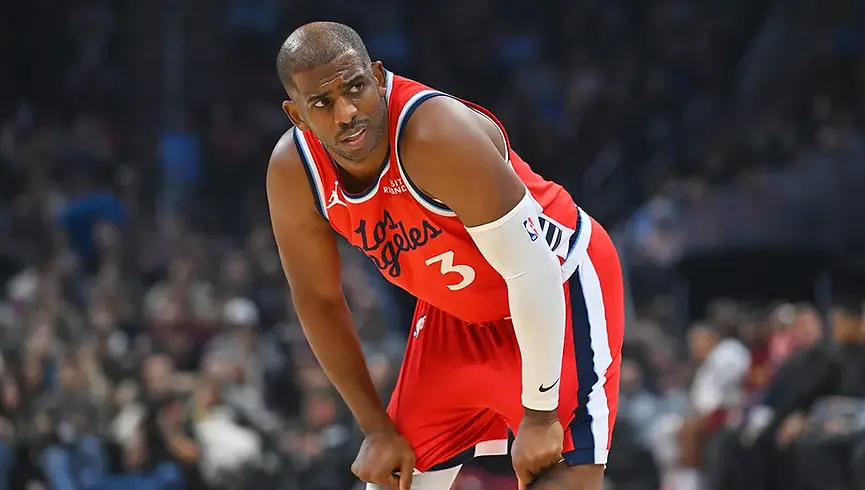
Chris Paul announced Friday that he is retiring from the NBA, bringing an illustrious career to an unceremonious end. Paul was traded by the Los Angeles Clippers to the Toronto Raptors in what amounted to an awkward breakup that effectively pushed him out of town—and out of the league.
Paul appeared in just 16 games for the Clippers, averaging career lows, as reports surfaced of tension between him and head coach Tyronn Lue. It was widely reported that Paul took issue with Lue’s coaching decisions and that the two had not been on speaking terms for several weeks prior to his departure. Paul reportedly requested a meeting to address allegations that he was a “negative presence,” a request Lue allegedly declined.
Conflicts with coaching staffs are not new territory for Paul. He famously clashed with former Clippers head coach Doc Rivers over coaching and personnel decisions before being traded to Houston in 2017. Paul’s relationship with another former Clippers head coach, Vinny Del Negro, fell apart just as quickly. It was rumored that Paul was fully responsible for the Clippers’ front office choosing not to renew Del Negro’s contract.
But Paul has always branded himself as a fierce competitor with immense basketball IQ—conducting an NBA offense with precision and executing perimeter defense at a ferociously high level. His final career numbers and personal accolades are outstanding: Paul finished as an 11-time All-NBA player, 7-time All-Defensive player, 12-time All-Star, 2-time Olympic gold medalist, and ranks second all-time in assists. In fact, Paul is the only player in NBA history with 20,000 points and 11,000 assists. CP3 was also a member of multiple 60-plus win teams and anchored the “Lob City” era—one of the NBA’s most exciting periods.
Unfortunately, Paul will likely be remembered as one of the greatest players to never win an NBA championship, joining a humbling list alongside Charles Barkley, John Stockton, and Elgin Baylor. But why? Why is the NBA’s greatest floor general retiring this week without a championship? It certainly didn’t help that Paul had to battle through multiple dynasties, while also dealing with untimely playoff injuries and a handful of postseason collapses. It’s a fair question—did injuries rob him, or did his control-heavy, coach critic style limit his team’s ceiling?
Chris Paul’s approach emulates a different, more competitive era. His intensity and focus are more reminiscent of Michael Jordan and Kobe Bryant—not the social, country-club mindset that permeates the league today. Paul didn’t play to make friends on the court, and you’ll rarely ever see him smile during a game. He was obsessed with details, preparation, and long hours in the gym perfecting his craft. It was his duty to push the competitive envelope and mentor young players—constantly maximizing the potential of both veterans and stars. But why was Chris Paul not rewarded with the same championship success as Jordan and Kobe?
For starters, Kobe and Jordan both benefited from an elite mind on the sideline in Phil Jackson. No disrespect to Doc Rivers, Ty Lue, or Vinny Del Negro, but that’s a different tier of coaching gravitas. Fair or not, it often felt like Paul was navigating against the philosophical ineptitude of his own bench.
You’ll never hear CP3 use this as an excuse, so I will—being six feet tall in the NBA is a structural disadvantage. He wasn’t built in a lab like most superstars. He had to manufacture separation, absorb contact, and out-maneuver defenders on every possession. Physically, Paul was swimming upstream his entire career—and still forced his way into the greatest pure point guard conversations of all time.
And here’s the larger point: system and structure matter. Having confidence that you are playing for a championship-minded coach matters. Jordan and Kobe were amplified by structure—the triangle offense, organizational stability, defined roles. Paul often was the system. He didn’t inherit an ecosystem; he had to construct one. Paul’s elite playmaking engineered offense, and he single-handedly elevated the careers of his front-court teammates. Every stop he made instantly became more disciplined, efficient, and competitive. That’s not coincidence—that’s orchestration.
Paul’s departure from the Clippers was nothing short of humiliating, especially given the enormous value he brought to a team that rarely had direction without him. The subsequent trade to Toronto and retirement announcement was the proverbial knockout blow to an all-time great player. Unfortunately for Paul, he played in a sport that overvalues championships and too often disregards careers of greatness for the title-less. Chris Paul wasn’t undeserving of a championship—fate and circumstance simply weren’t on the Point God’s side.
