


Read the Game Differently.
Daily Sports Betting Picks | Betting Analysis | CFB | NBA | MLB | NFL | Game Previews
By Matt Godbee
5:44 PM EST on April 25, 2026
It feels like an eternity ago—the relentless steroid coverage that hung over Major League Baseball for the better part of a decade. It was a perfect storm, and not in a good way. Steroid use wasn’t just widespread; it was visible. Players began to look more like professional wrestlers than baseball players, and in the process, they were dismantling something far more sacred: the record books.
Because unlike most modern leagues, baseball doesn’t just sell competition—it sells history. The sport carries a lineage that stretches back to the 1800s, where figures like Babe Ruth and Ty Cobb feel less like former players and more like permanent fixtures of American mythology. Their records weren’t just numbers; they were part of the game’s identity.
And yet, during the steroid era, those marks fell—quickly, loudly, and often without apology. There was an edge to it, an arrogance that only deepened the backlash that would follow.
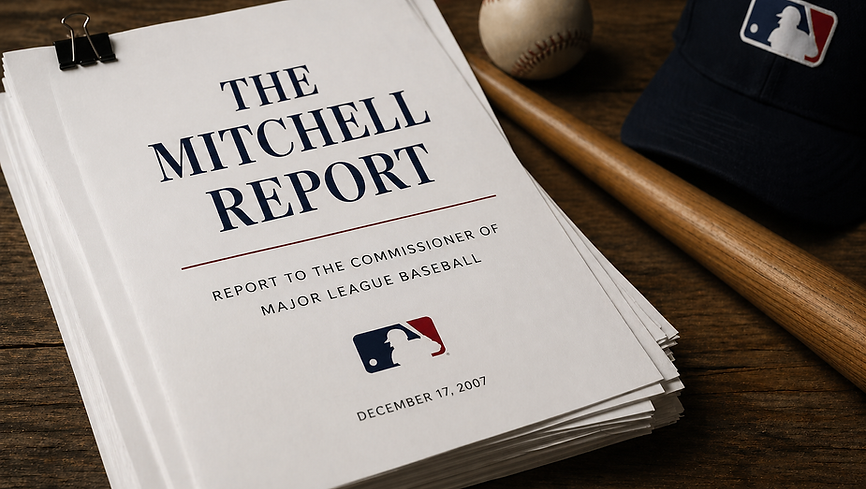
Nearly 20 years later, the Mitchell Report remains one of the most consequential documents in the sport’s history. The time has come to reassess what it actually changed—about the game, the players it implicated, and the records it helped redefine.
In 2006, then-commissioner Bud Selig appointed former senator George J. Mitchell to lead a comprehensive investigation into performance-enhancing drug use in Major League Baseball. The move came amid mounting congressional pressure and the release of Game of Shadows by San Francisco Chronicle reporters Lance Williams and Mark Fainaru-Wada, which detailed the alleged widespread use of steroids and human growth hormone among some of the game’s biggest stars.
The mandate was broad: identify players, establish levels of culpability, and recommend meaningful changes to testing and prevention. In many ways, the report delivered—though not without controversy. Mitchell faced criticism from both the media and the Major League Baseball Players Association over perceived conflicts of interest and questions of bias. Still, the final product largely met public demand for accountability at a time when the sport’s credibility was under real strain.
The investigation—and the eventual release of the Mitchell Report—was met with enormous resistance from the Major League Baseball Players Association, which was hardly surprising. The MLBPA, one of the most powerful unions in professional sports, effectively advised players to avoid cooperation.
Without subpoena power or the ability to compel document production, Mitchell was forced to rely heavily on voluntary participation and previously obtained evidence. That limitation became a central point of criticism. Many argued the report was inherently uneven—implicating some players while allowing others, equally culpable, to avoid scrutiny altogether.
Mitchell also faced backlash over perceived conflicts of interest, particularly the limited number of players tied to the Boston Red Sox—an organization he had been affiliated with—and the Milwaukee Brewers, formerly owned by commissioner Bud Selig.
At the time, most fans associated steroid use with fringe athletics and bodybuilding—not the core of a major American sport. What many didn’t fully grasp was the growing role of substances like human growth hormone, which was largely undetectable at the time and widely believed to enhance recovery, strength, and overall performance while allowing players to pass standard drug tests. It was imperative that Major League Baseball addressed the use of these substances—and, more importantly, establish a comprehensive testing standard that could identify and punish offenders. Though it took time, the league largely accomplished that.
The players at the center of the Mitchell Report included seven-time Cy Young winner Roger Clemens and World Series champion Andy Pettitte. Of the two, only Pettitte ultimately admitted to using performance-enhancing drugs during his career. Clemens, meanwhile, has never acknowledged using steroids and was later charged with perjury and obstruction of Congress—charges he was ultimately acquitted of after a lengthy legal battle.
Barry Bonds presents a different kind of case. He was not named in the Mitchell Report, but his connection to the BALCO scandal and related testimony strongly linked him to performance-enhancing drug use, despite his consistent denial of knowingly taking such substances.
Alex Rodriguez followed yet another path. Initially tied to failed anonymous drug testing, he was later formally implicated and suspended as a result of evidence and testimony stemming from the Biogenesis scandal.
The players’ reputations have never fully recovered. Clemens, Bonds, and Rodriguez remain on the outside looking in when it comes to the Baseball Hall of Fame. Their careers have been permanently marked by the steroid era. They’ve become the flag-bearers for a chapter of the sport that Major League Baseball would prefer to distance itself from. Voters have shown a willingness to forgive in other cases—but that same benefit of the doubt has largely not been extended here.
Nonetheless, Major League Baseball has largely cleaned up the sport—and it deserves credit for that. The league has acknowledged its own role and, over time, built a system designed to detect and punish performance-enhancing drug use. Many players have admitted their involvement, but the era’s most prominent figures have largely held their ground, maintaining varying degrees of plausible deniability.
The game itself has also evolved. What once felt like a home run race driven by power at all costs has given way to a more analytics-driven era—one defined by consistency, optimization, and measured growth. Players are still testing positive for performance-enhancing drugs—and they always will—but MLB has made testing more sophisticated and penalties more meaningful. The result is a system where the consequences are real, both financially and reputationally.
That deterrence is now part of the sport’s structure. Even the MLBPA has, over time, accepted a role in enforcing stricter standards. The unintended consequence is a higher level of accountability for today’s players—many of whom are judged in the shadow of a previous era—but that is, in many ways, the cost of restoring credibility.
Gone are the days of openly questionable records. Fans are less quick to question breakout seasons or assume wrongdoing. It’s no longer common to see players show up to Spring Training dramatically transformed, and steroid-driven headlines no longer dominate the sport the way they once did. There was a time when the pessimism of the steroid era felt unavoidable; today, that stigma has largely diminished.
The Mitchell Report didn’t end performance-enhancing drugs in baseball—it changed the cost of using them. And in doing so, it changed the game.
